Showing posts with label Articulation Therapy. Show all posts

March 2, 2013

Feelings and Emotions ~ Literacy, Language and Social Communication Activities ~by Orlanda

Whew! It's been a while since I have posted, but Kelley and I have been working HARD in our speech and special education classrooms and trying to balance work life and home life! We have spent the last few weeks with a focus on FEELINGS and EMOTIONS with many of our students. We have been using the Emotions Cue Card created by Kelley in all of our sessions to help our students identify their own emotions at the beginning of each social group session. We have found that some of our students have difficulty describing their own emotional state, so we talk about it every week!

Kelley and I work together with a wide variety of students with language, social communication and social behavioral needs and this topic is ongoing for all of these students. In addition, I work with many students with language impairments that have difficulty describing feelings as it relates to others or characters in stories that are read and heard as well as in their own oral and written expression. So, in addition to the groups that we teach together, I have been working on this skill with ALL of my groups. I even managed to incorporate many articulation goals with this lesson, here's how I did it....

We started in our social groups and speech/language groups reading these stories:


The Way I Feel was great with ALL of our young age groups (3 year olds-2nd grade students). It was easy to modify the language throughout the story and match emotions pictures. Today I Feel Silly & Other Moods That Make My Day was was great for students Kindergarten through 2nd grade because it had more words and more details in the pictures throughout the story. How Are You Peeling? Foods with Moods was a little too "abstract" for my younger students to recognize the feelings or emotions depicted in the photos, but it was great for my 1st and 2nd grade students. While we read each of these books, we had the Emotions Cue Card handy to match feelings from the book to the photos on the cue card. Additionally, I collected many other Emotions Photos to match feelings and emotions throughout these stories. Several of our students have difficulty understanding and seeing that people depict similar emotions in slightly different ways, so we wanted to offer a variety "faces" for our students to help them see and understand the similarities/differences between faces and feelings. Here is one page of the Emotions Photos that I used for my students to match and describe emotions.


This Emotions Photos document is 4 pages of photos depicting Happy, Sad, Mad/Frustrated, Calm, Scared and Tired. You can grab it here. I turned these photos into cards by cutting the pictures out and laminating them onto large index cards.
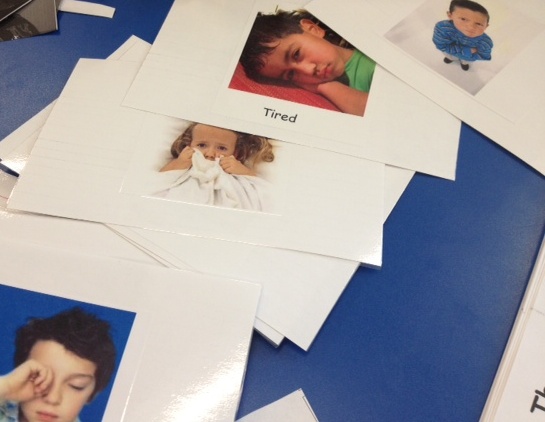

While reading all of the Feelings books, we targeted goals such as Answering Basic Questions, Describing details in pictures and using Inference to determine the character's feelings. Each time we read the books, we used the Emotions Photos to match the feelings of the characters. For students in articulation therapy, we continued to use these books and activities and were able to focus on phonemes such as /f, s, sm, sk, l/ to name a few.

After reading each of the stories (over 2-3 sessions), we started making our own book of feelings. With our young kindergarten group, we have several students with low receptive/expressive language skills and poor social communication skills. In this group, we have targeted each emotion in our own book in 1-2 sessions. We started each "emotion exploration" using a computer software program called Faceland.


We LOVE this program because it teaches the students what "clues" to look for on faces to determine the emotion. Each new emotion that is taught is broken into 2-3 facial cues from the eyebrows/forehead, eyes, and mouth. This program also allows the students to see the same emotion depicted in slightly different ways between different people. There are also questions that it asks, and the students have to match the situation to the emotion. For our young students, we often have to act/draw out these questions to help them understand; however, it really helps them learn the feelings. There are even follow up games that go along with each emotion, so it is very engaging!

After going through Faceland, we started making our own book called "My Book of Feelings". Here are some sample pages from this book:


We took pictures of our students depicting the emotion that was stated on each page. This was easiest to do during our Faceland activities for some of our students. Others just needed the Emotions Cue Card or Emotion Photos and a mirror to match their own faces to the feelings. Some students enjoyed taking their picture using the iPad with the camera in "reverse" mode so that they could see themselves making the faces. Still, some of our youngest students (3 year olds) had a hard time making the faces that they were not feeling in the moment, so we improvised by using other pictures or catching them in the act! Needless to say, this was one of the most fun parts of the activity, and all of our students LOVE seeing pictures of themselves in their own books! Here is how one turned out!


Our students with expressive language impairments had some difficulty independently coming up with "things that make me feel ___" so I created a document with pictures for the kids to choose from. A sample of this document is pictured, but you can grab the entire document HERE.


We also found that different students had different feelings about the pictures offered. For example, one of our students feels HAPPY when tying her shoes but another said that this made him feel FRUSTRATED because it was hard for him.

For our youngegst students, we also used the Emotions Photos cards to discuss Similarities and Differences and the "I Feel __ When" cards to Categorize emotions. For our older students in speech/language therapy, we continued expanding this lesson by coming up with synonyms for the feeling words and using them to re-tell or create stories of our own. In their Book of Feelings, we made it harder by having them expand their own stories with their personal experiences.

This has been a great activity for ALL of our students. We have had the opportunity to learn so much about them and they have really improved their ability to describe their feelings and the feelings of others. AND, they will be able to share their books with their families for ongoing conversations at home!

We hope you find these activities useful with the speech, language, and social communication needs of your students! We'd love to know How You Feel about these activities and how we can make them even better!

   ~~Orlanda

December 11, 2012

Simple Speech ~ "The Gingerbread Man" : Activities to Target Speech, Language and Literacy

Wow! This semester in school is flying by, we only have 7 more days until Winter Break! I feel like I have been drowning in paperwork and evaluations and my student caseload keeps growing! Thankfully, we are in one of my favorite times of year, the Holiday Season!

Because I work with such a diverse population of students and cultural backgrounds, I really have to focus on choosing diverse activities that allow us to celebrate the season in many different ways. My favorite book to read this time of year is "The Gingerbread Man". It's a fun story about something that we all enjoy: COOKIES! This year, I have collected MANY versions of this story to enjoy with my students!


The goals that I target during these activities include the following:
Articulation/phonology: multi-syllable words/phrases; final consonants; phonemes: "dge", /f/, /k/
Receptive language: Recognizing animals, actions, positions
Expressive Language:  Core Vocabulary--"In, Out, Go, Run, He, She, They"; Answer Who, What Doing, Where and Why Questions; Problem solving; Inference; Predicting; Story Grammar; Sequence; Re-telling stories, Compare/Contrast
Pragmatic Language: Feelings/emotions, Non-literal language/Metaphors ("Sly as a Fox")

I started by reading this version: "The Gingerbread Man". In this version, the fox tricks the gingerbread man by telling him, "Come closer, I can't hear you". The kids love this one because we all YELL together like the gingerbread man, "I have run away from . . . .!" and then we list all of the characters.


Then I read this version of the book:

I talked to the students about "folk tales" and why there are different versions of this story. The second version of the story has more details about the process for making gingerbread and has new vocabulary like "sugary glaze". This version also has different characters from the first version of the story.

While reading each story, we focused on the articulation and phonology goals using the repetitive text "Run, Run as fast as you can, you can't catch me, I'm the gingerbread man!" Then, after reading each story (usually during the second session), we retold the story using this visual that I created: Retell the Story. This is a great tool that we used to identify the Story Parts and practice Sequence skills. This is also helpful for identifying details and events from the a story.

After retelling each version of the story. We were worked on compare/contrast of the stories. I use a simple Venn diagram to compare/contrast the stories. I found a new idea on how to do this on Pinterest using paper plates. What a great idea! Here is the link to the post: Paper Plate Venn Diagrams


The kids have been so engaged that I sought out many more versions of this story and have them laid out. They ask every day which book we will read next! So, we also read these stories and completed the same kinds of activities. Here they are:


The kids have done such a great job and have been really engaged in pointing out similarities and differences while we have read the books. I have been using these activities with Pre-K through 2nd grade students. I even used the first version of this story in my youngest pre-school group. I found lots of Gingerbread Man activities on various websites, here are some of my favorites!

Sequence pictures and a mini book:

Gingerbread Man themed games and websites:

YouTube Links for Gingerbread Man story and How to Make Gingerbread cookies:

I really like the video "Gingerbread Men Recipe Demonstration". It's kind of long, so I fast-forwarded many parts, but it was great for my students to see the process for making gingerbread cookies. Many of them thought that decorating and eating were the only steps! The last activity that I did with the kids was to make cookies with them. I had them list the steps for making the cookies and I purchased some Gingerbread Cookie Mix. We did this hands on activity to complete the recipe, bake the cookies, decorate, and EAT (everyone's favorite).

If you have students with diet restrictions or have limitations in making real cookies, we also had lots of fun using the Cookie Doodle app on the iPad. Using this app, you and your students can walk through the steps of mixing the ingredients, baking, and decorating. It's fun, too!


I hope you have fun using some of these Simple Speech "holiday themed" activities with your students! What are your favorite books or activities to use during the holiday season?

~Orlanda

May 10, 2012

Reaching the "100" goal


If you are an SLP who sees most of their students in small group therapy, raise your hand.

If you are an SLP who sees students in articulation therapy and finds themselves getting "creative" to practice articulation skills "around the table", touch your nose.

If you are an SLP who struggles to get more than 30 trials per student of articulation practice during a small group therapy session, pat your head.

If someone near you is looking at you strangely by now, then that means one or all of these scenarios apply to you, and we have something in common!

If there is one thing that we all know as SLPs, it's that getting a child to correctly articulate their speech sound target is a great feeling (whatever level they are at). Getting that child to do that 20 times in a session is great. Getting that child to achieve that target 50-75 times per session would be ideal! And, for that matter, getting that child to exceed 100 trials correct in a single session would be AMAZING! This is so important because we typically only see these students once or twice a week for an average of 30-45 minutes per session. That means, in 7 days, the child MIGHT say their sound correctly 100-200 times. This also means they might say this sound incorrectly when they are outside of the therapy setting 500-1,000+ times (depending on their sound target)! I just kept thinking about these odds and wondering, "How can I possibly achieve a minimum of 100 correct trials per session?"


Then it hit me one day. . .I want to try using the "speech lab" concept IN the therapy setting. The idea of "Speech Lab" was presented through RtI presentations in our district and has been used in many districts around the country. The idea during RtI is to use a "general education articulation lab" and see if students would be able to master their articulation errors in a short, intensive program without going through a full referral and evaluation process.  In the "speech lab," students rotate through various "centers" to practice their sound targets and are facilitated by a "roaming" SLP.Programs seem to vary around the country, and in our district we have "piloted" such an idea; however, we have not fully implemented this. Super Duper Publications even has a product specifically for implementing such a program in RtI with their resource "ARtIC Lab: A Bilingual Response to Intervention Program for Articulation." Follow this link to find it.


So, as I said, we do not currently implement an articulation lab in our district, and I do not currently own a specific program. However, I have taken the concepts and practices, and started to implement them in my own speech room. I needed to be more efficient with my time and my students' time in groups of 4-5 students. In my speech lab, I have students rotate through stations for 4-5 minutes per station. My stations include "Listening Center", "Table Time", and "Sounds on the Carpet". Here is a description of each station:

Listening Center--In this station, I have students sit at my desktop computer and listen to their targets. I have done this a few different ways. I have used the "Garage Band" software to have students strictly listen to words that I voice recorded. I also used "Power Point" to create several presentations where I have paired pictures and words with my voice recorded. This seems to be more motivating for the students because they can "click" through the pictures. While the Power Point presentations are my favorite, they take a little time to create. Unfortunately, my files are too big to share here at this time. For students who have minimal stimulability, I have them "listen only." As my students increase their accuracy of production with minimal cues, they are instructed to listen AND say the words they hear.

Table Time--I use this opportunity to get 1:1 time with each student. While they are with me one on one, I target the sound that is the hardest or least stimulable for them. My goal while I'm with them individually is to increase their stimulability so that target can be transitioned into a more "independent" station.

Sounds on the Carpet--In this station, it is VERY important to have the students practice their targets at the level that requires the least amount verbal cues. I have taught my students how to provide "friendly cues" to each other and encourage each other. Also, since my speech room is pretty small, I am in "earshot" of each student and can offer added cues or change their target if I don't hear accurate productions. Also in this station, the students can engage in "quick" games to motivate them such as "Trouble" or "Uno".

During speech lab, I use the tools that I have on hand and I have even created some new ones. Here is what you might need if you want to try this, too!

1. A schedule for the "Speech Lab" rotation.--Grab mine here. This is what my schedule looks like:


I have it laminated and hanging on my white board. Since it is laminated, I am able to write the students' names on the schedule to let them know what "station" they are scheduled for. On the carpet, I usually have 2-3 students at a time (my preference is 2)

2. Articulation targets per student--I use artic cards or worksheets for this. My younger students do better with cards or sheets they can access in the speech room. My older students each have their own folder with their individual speech targets and they bring them to and from their speech sessions.

3. A Table or "area" with tools you will need for some 1:1 time such as a mirror, tongue depressors, gloves, data collection sheets, etc. for "table time". You might also want to keep a Speech Target handy. Grab mine here: Speech Target.
                          

4. Motivating games for "sounds on the carpet". We like "Trouble", "Uno", "Topple", "Look Who's Listening," or just a pair of dice.

5. Counters. We used to use tally counters; however, they broke easily (guess I shouldn't have "cinched" on the brand). Now we just use post it notes and the students tally count their sound productions. Each student is responsible for keeping up with their own count and they use tally marks. At the end, they count up their sound productions and they love counting by fives, even my kindergartners!

6. Computer or voice recorder and headphones for listening station. We use a desktop, but anything that records your voice will work. My next step is to try my new Live Scribe Echo Pen (but that will be saved for a future post).

7. A timer. I set it for 4-5 minutes per station. When they hear it, they look at the schedule and make the switch!

8. Motivator chart. This can be accomplished in ANY way. I challenge each student to say their sounds at least 100 times per speech lab session. Then I set a "group goal" to work for a prize speech day such as a "Game Day" or "Popcorn Party". I have used a pom pon jar, a sticker chart, and a graph to track their progress. They are increasingly excited when they see their progress against another grade level!

In my experience since starting "Speech Lab", here is what I have noticed:
  • Taking the time to "teach" the expectations for each station is a MUST!
  • It works BEST with students once they reach the syllable or word level of their target sound.
  • It's best for speech practice up to the sentence level. (Once a student starts connected speech tasks, it can be done, but you have to get creative.)
  • It works best with at least 3-5 students; more or less I have found to be less effective and less motivating.
  • It doesn't work very well for students with minimal stimulability.
 I have shared my experience with some of my colleagues, and the most common question that I have received has been: "How can you say that you are giving them their speech time when they are not face to face with you?" My response is, I AM face to face with all of them while they are in my room, and they are CONSTANTLY practicing their speech targets instead of waiting for their peer to finish before they can start. They are still required to be active listeners also, and I have TRIPLED the targets produced correct per session. I have now seen more students reach connected speech tasks at a much faster rate than ever before!

If "Speech Lab" sounds like fun to you, I challenge you to try it out! So, put your had down, take your finger off of your nose, and quit patting your head. . .instead, get started toward reaching the goal of 100 trials correct per session!

Have Fun!
~Orlanda

May 1, 2012

Collaboration in Speech Therapy and Special Education--A Success Story

In honor of Better Speech and Hearing Month, we thought we would kick of May with a success story from our collaboration through speech therapy and special education services.

The story begins with a kindergarten boy . . . This young boy melted our hearts the moment we laid eyes on him, an adorable and huggable little guy. He came to us as a kindergartener after his previous educational team had deemed it necessary for him to have a second round of kindergarten. During his previous year in school, he was evaluated and found to have a speech and language impairment and had begun receiving speech therapy earlier that spring.

It didn't take long for us to realize that this child's challenges far exceeded that which could be provided by traditional speech therapy services alone. In addition to his deficits in articulation and language, he struggled with listening/attending skills, social/behavioral skills, and academic skills. As his SLP and case manager at the time, I had to work closely and diligently with his teacher and the campus staff to collect sufficient data needed in order to provide additional services. Thanks to an amazing campus and administration, we were able to begin providing him with additional inclusion and resource supports through our Social Communication Resources and Services Program while he was being evaluated for an additional disability.

As we began developing a program for this student, Kelley and I worked collaboratively to develop social stories in order to teach him school rules and routines. Kelley also worked diligently with the classroom teacher to develop positive behavior supports and teach behavior expectations through the use of discrete trial techniques. These same techniques were also used during his small group pull-out sessions in speech therapy and in the areas of reading and writing. Kelley and I also included this student in a co-taught Social Thinking group and started directly teaching social thinking skills such as Whole Body Listening and Expected and Unexpected Behaviors. We, along with his teacher and administrators, worked diligently through months of tantrums and tears with this child. As he came to the end of his kindergarten year, we saw significant changes in his behavior and attention.

Also in the midst of chipping away at this students behavioral challenges, we used collaborative efforts and techniques to make changes to his speech, language, and academic skills.  In speech therapy, I focused primarily on his motor speech deficit in a small group with 1-2 other students. It wasn't long before Kelley inquired about how this was being accomplished and she quickly was on board with trying out a new program to work on his reading skills. Together, we used various aspects of the Lindamood Phoneme Sequencing Program for Reading, Spelling, and Speech or LiPS Program.


This program, developed by Lindamood Bell, has a great series of visuals and techniques for developing all skills related to speech, reading and spelling. From a motor-speech aspect, I have used the Mouth Pictures and corresponding Phoneme cues to teach articulation skills. The cues are very descriptive and easy for students of all ages to understand.


Using these cues in speech therapy and then transitioning the same cues into this child's resource classroom really seemed to bridge the gap for him as he learned to identify and name letters and sounds and then sequence these sounds with appropriate coordination for speaking and reading. Using a multi-sensory and collaborative approach for this child significantly contributed to his progress in speech, language, reading, and writing. This type of program is inherently designed to help coordinate the development of all three of these skills. I highly encourage SLPs and teachers to coordinate their efforts and combine their expertise regarding motor-speech and oral language development with developing reading and writing skills.

Thanks to a great TEAM approach, this child is now at the end of his first grade year speaking with much greater intelligibility of speech, reading independently on grade level, and writing on grade level with minimal accommodations and daily supports. He remains in speech therapy to support continued increases in intelligibility of speech, particularly in the area of sequencing complex co-articulation as well as improving expressive syntax to age appropriate levels. But overall, this student's success is clearly the result of a collaborative approach.

~Orlanda

March 18, 2012

Articulation Therapy Tools

Time for me to share some of my favorite self-created articulation therapy tools!  I have many tools that I have created over the years and will be sharing more soon, but here are some starters.  These two visuals are permanent fixtures in the speech therapy room!

First, I want to share the Speech Target.  Here it is.


In my recent Pinterest and Blog browsing, I have seen similar "rubric" styles for articulation therapy, and I think it's a great idea.  The idea of using a rubric in articulation therapy came to me a couple of years ago after attending a training that focused on language therapy.  I found that I needed a way to give some positive feedback to my students in articulation therapy that were really "stuck" at becoming stimulable for their target sounds.  (The most trouble, as always, has been that R sound!)  I knew that my students were working their tails off with their oral motor exercises, traditional drill practice in therapy, and consistenly completing homework activities.  I could "hear" changes in their speech even if their targets were not completely accurate, so, the Speech Target was born.  Of course, the first one was scribbled on a piece of paper (as many great ideas begin).  But it didn't take long for my students to understand the purpose of the target and to feel their improvements.  Eventually, they were able to accurately discriminate their own speech on the target with little guidance from me.  Sound production was no longer "right" or "wrong" in speech, instead they were getting "closer to the bull's eye"! Now, the Speech Target permanently hangs on my white board and I refer to it frequently in therapy.  Occasionally, I even have the students rate each other on the target to maintain attention of all group members and give them some friendly feedback from their peers. 

Here is the other Articulation Rating Scale I found on Pinterest thanks to the folks at Peadia Staff.  This one was created by speech/language pathologist, Dala, and can be seen on her blog here: Testy Yet Trying.


The other tool that I refer to often in my speech room is the "Good Speech Posture" poster:

Most of my students in articulation therapy focus on some level of oral motor exercises at the beginning and throughout each speech session.  As many SLPs know, lots of our kids with articulation disorders have trouble with isolating their "speech helpers" from each other.  For example, many kids working on tongue tip elevation may be able to achieve this only when they raise or tilt their entire head.  Many times the entire head or body will move in the direciton of the tongue and the same goes for the jaw.  So, I have worked really hard to teach my kids the importance of good posture and moving their speech helpers independently from the rest of their body.  While this is the target for many of my students, there are some students who need the added body movements in order to achieve their phoneme production, but this is a nice tool to have around, especially for my wiggly speech students! 

I hope you can find these tools useful in your speech room!

     ~Orlanda 


March 3, 2012

Super Duper© Data Tracker App = LIFE SAVER!

Data drives EVERYTHING!!! Am I right?  And it should, no doubt about that. . .but keeping up with it is a craft that many SLPs and Teachers work hard to perfect every day!

Well, the awesome folks at Super Duper© Inc. are at it again with the addition of many apps for iPhone, iPad, iPod and now Android.  I recently purchased the Super Duper© Data Tracker App and have not regretted my $5.99 purchase!  I am a bit frugal, so I "phoned a friend" before making the purchase and she said that while she didn't frequently use it, she thought it might be worth it.  So, I took the plunge and haven't looked back!  I will say, this is not the ONLY source of data collection for me because of how it is set up. So, let me tell you about it and then I'll fill you in on how I use it to make my life easier!


When you buy the app, you first have to set up your student profile by adding "players" and assigning goals to each player.  You will also assign your measurement method by choosing from correct/incorrect or adding "approximation" or "cued".  I love that it has so many options!  I have recently started using this tool more frequently for language targets by choosing the "four" options:  correct, incorrect, approximated (or what I use as a cued incorrect response) and cued (or what I sometimes use as a cued correct response).  My co-teacher, Kelley has started using the "approximation" to count the cues per session.  The beauty of it is that you can make it work for you! 

Also from this screen, you can add a player to a "group".  This allows you to put your "data sheets" together by group.  There is also the flexibility to track data for one student at a time whether they are in a group or not, and there is also an option to remove a player from a session if they are absent.


The other cool thing is that all of your data is CALUCULATED FOR YOU!  Yes, you heard me right, you DON'T have to calculate your own data!  I think this is what takes me the longest and this is the best part about it.  And I know that all the speechies out there can identify with couting tally marks!  This is what it looks like.  You can even choose to email the data if you need to, which would be great for sharing with parents or printing for your data books!

In a recent update, they also added a "graphing" option, which is another great visual for showing progress to parents or teachers.  You can choose the date range or range of sessions to show for each student. Check it out!


I know, it's pretty amazing, isn't it!  Click this link for a video tutorial from Super Duper©.
.

Super Duper Data Tracker App Video

Now, here is the trick to using this tool. . .and the one that is "make or break" if I use it in a therapy session:  it is easiest to use this tool in an individual session OR in a small group session (2-3 students) or in a session where turns are clearly defined and used.  I can use this tool in structured groups of up to 4-5 students, but if they are not great at taking turns, it's easy to mis-mark data.  The reason for this is that you cannot see multiple player goals on one screen.  When using this tool in a group, you have to swipe the top of the screen to switch players.  In my opinion, this tool is MOST useful in my articulation therapy sessions where I am working to attain over 50 trials per student and sometimes with multiple targets. I have also learned that many sessions can be stored until I get that "free moment" where I can put the data in my service log for each student, but now that takes only a few minutes per child!

As you can tell, I love this new tool from Super Duper© and maybe you will find it a useful time saver, too!

    ~Orlanda

February 25, 2012

Simple Speech ~ "It Looked Like Spilt Milk"

Spring is beginning to "spring" in my school, and what does that mean? A WAVE of new referrals for speech/language testing!  So, as a result, the little time I had for planning therapy sessions has dwindled from minutes to seconds on many days. . .I know, I know, planning is very important in speech therapy, in classrooms, yada, yada, yada. . . but the reality is, when you are a school-based clinician with MANY kids and often multiple schools (or in my case, keeping a growing caseload and supervising two new SLPs who are in their CF year. . .), you do what you can to keep your head above water some days and manage to get the job done.  Fortunately for me, I have been at this a while, so I have many "go to" activities that I can make work for just about any student (particularly the young ones, PK-1st/2nd grade).  So, I thought I'd share my SIMPLE SPEECH activity of this week (meaning it required only a few materials and little to no prep time before the speech session). . .I'll keep adding to the list of "Simple Speech" activities. . .in my spare time. 

For this week, I pulled in an activity that I have done for several years now.  I was introduced to this book and craft (origin uknown) during my days working on a district speech therapy program that focused on intervention for 3-5 year old students specifically with articulation and expressive language impairments. That program has since fallen victim to "budget cuts", but the ideas and activities live on and I try to find ways to add to them or expand them for my slightly older students each year! The book used for this activity is "It Looked Like Spilt Milk" by Charles G. Shaw.  Here it is:

It's a pretty popular book if you haven't already seen it. Check in your school library or with your fellow teachers or SLPs and I'm sure you'll get your hands on it quick!  In this story each page has a white "figure" of various objects such as an ice cream cone, a birthday cake, a rabbit, etc.  Also, it is filled with repetitive text by including the same phrases on each page.  At the end of the story, you learn that each of these figures is actually a "cloud" in the sky.

Some perfect articulation targets for this book are: word-initial L and word-final K because you'll see the phrase "Sometimes It Looked Like. . ." on each page. Some Language targets that I used with this book this week were: temporal phrases ("sometimes"), regular past tense ("looked"), describing (have the students describe details as to "how" they could tell each figure was a particular object).

With almost all of my students I can read the first page or two and they can "read" the rest because it is repetitive, and this offers many opportunities to practice these articulation and language targets.  For kids who might not do that, hearing it first is a great way to bombard the auditory system with these sound targets.

I really like to choose activities and stories that I can continue for at least 2 sessions. So, with this activity, on the first day, we read the story, described each figure and discussed the children's experiences with seeing "pictures" in the clouds. Then we made our own "cloud" paintings.  Here is how a few of them came out, what do you think you see?

The way we did it was, I took a half sheet of blue construction paper (light or dark would work), and I folded it to give it a crease and a "target" for the child. I gave each of them a paintbrush and white paint and gave them instructions (and modeled) on how to paint their picture by "dabbing" paint in any way they wanted near the center of the paper.  <By the way, this helped me add in other language targets regarding "position" and "following directions". I even had my students who need to work on comprehending instructions repeat the instructions back to the entire group>.  Then they were instructed to paint for a few seconds (about 10) until I said to stop. Finally, I had them fold the paper over and "spread" the paint. When they opened it up, it really changed their picture and they were very creative in describing what they saw in their "clouds".  It's a pretty quick project, so each student was able to make three clouds.  That took our entire session and this gave our paintings time to dry until the next session.

In our next session (or maybe even 2 more sessions depending on time allowed), we had more fun with this story and activity. Of course, we started with recall/retell (another language target), and then I took the students outside on a "cloud walk" and we walked around the school observing and describing clouds.  It was a GREAT way to work on generalizing these targets in conversation and outside of the therapy room, and it was nice to get some fresh air! After that (either the same day or the next), we came back to our cloud paintings and assembled our own "book".  I gave each student a "cover" using a blank piece of the same colored construction paper.  For the younger students, we came up with a title together and I typed it and printed it out so they could glue it to their cover. They were also given the opportunity to illustrate their cover with crayons.  Then we added our own words to the book.  For my younger students, I wrote the words in their books or typed it up so they could glue it in.  For my older students, they wrote their own or dictated to me so they could copy their sentences from my board.  They all had a great time during this activity and they each have their own "published book" that they can take home and read to their parents.

This week I took pictures of their books.  Here they are!


I also assigned them homework to take their families on a "Cloud Walk."

I hope you enjoy this SIMPLE SPEECH activity with your students!

     ~Orlanda
February 13, 2012

Our Collaborative Data Documentation Sheet

Orlanda and I were comparing notes one day earlier this year about the seemingly bazillions of data documentation sheets that we had tried over the years and how none of them ever quite fit the bill. I showed her the one that I was currently using at the time and a few days later she tweaked the format using another data sheet she had tweaked from a colleague, and together we came up with a GREAT sheet. It has been really handy that we are both using the same format so when we are co-teaching, whichever one of us isn't direct teaching can pick up each other's data sheets and document data easily.

Most of my (Kelley's) sheets are 2 sided to allow for frequency data to be collected on one side (behavioral or academic)...


...and anecdotal data on the other side.


 Obviously, I just make a note of the goal to remind me what I'm tracking. When I calculate the data I correlate it to the criterion.

If kids have a lot of goals, they have a whole sheet to themselves. Students who are only working on a few goals or if I only see them in a group instead of working one on one or in the inclusion setting,  are put on a "group" sheet. That way I can pull one sheet out for a group and track data on many students at the same time.


I color code the sheets as well, so I can quickly retrieve the one I want and make notes.
Using the same data documentation sheets allows us to easily share data across sessions for those students that we share as teacher and speech/language pathologist. This has helped our data reports be even more thorough. It has also helped us to evaluate behaviors and skills across settings.

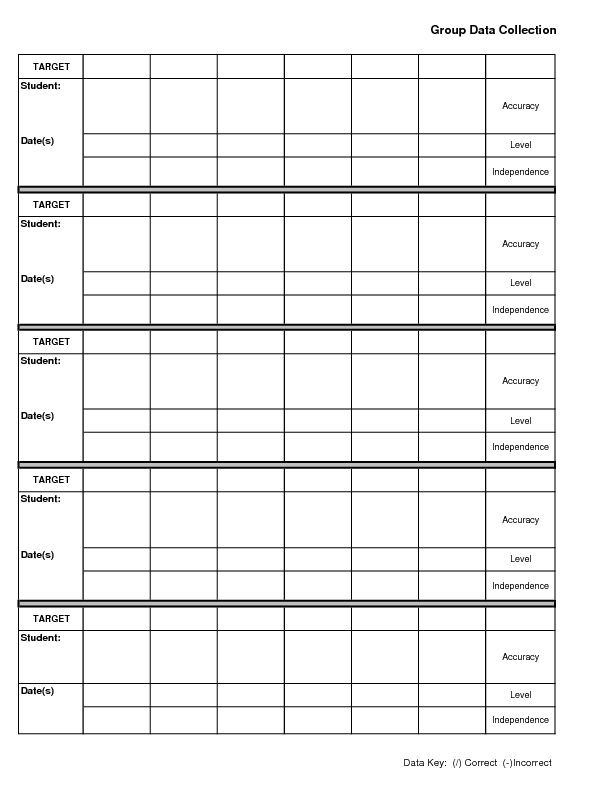
The Group data sheets that we are using can be found here:


We have toyed with a variety of ways to calculate and measure our data, and currently we have stuck with "Percentage of trials correct".  We have considered changing to a "rubric" system, but in the meantime, we have found this method to be the most useful and we just make sure we take GREAT notes when any "unknown" factors affect our therapy outcomes!  You will see in the data Key that we use a (+) for a correct response, a (-) for an incorrect response, and (O) means we circle the type of response when it was cued.  So essentially, we have four types of responses that we document:  correct, incorrect, cued correct, and cued incorrect.  The "notes" are an important place to document the "type" of cue needed, particularly if it was an extremely explicit cue (such as "hand over hand").

In speech therapy, I (Orlanda) use the above data sheet for group language sessions and even in fluency therapy.  I have also tweaked the same type of data sheet specifically for articulation therapy with the only change being to the data key and an added "level".  Find this data sheet here:


On this form, the "level" refers to one of the following:  isolation, syllable, word, phrase, sentence, connected speech, etc.  Also, I have switched from the (+) method to using tally marks (/) because they are much faster for me to count and calculate AND I can fit more into a box (considering my goal is always 50+ trials per session).  Then I use the "independence" slot to document the estimated amount/type of cues needed for each student.  I have another data sheet that is similar but is meant for an individual therapy session.  Grab it here:


We would love to take a look at your data systems. What system do you use? Email us and we'd love to share your ideas with others.         ~Kelley and Orlanda