Showing posts with label Language Therapy. Show all posts

September 4, 2013

Wow Us Wednesday ~ Lesson Plan Link Party!

We have a brilliant idea if we do say so ourselves....

Well, it will only be brilliant if YOU join in! There are so may smart therapists and teachers out there that work so hard to create purposeful and engaging lesson plans for students. I know I am guilty of re-inventing the wheel too many times instead of reaching out to ask for and share ideas with my fellow teachers.

So, let's change that!

On the first Wednesday of each month, we will open up our Wow Us Wednesday Lesson Plan Link Party. We will keep the links open from Wednesday-Tuesday, so check back several times over the course of the week to catch all the great ideas. Feel free to link up any great lesson plans that you would like to share and make sure to "like" the ideas that you really enjoy. We will feature the top three "liked" lessons in a follow-up post.

What's a link party you say? It is a great way to be linked up to other blogs and share information in one easy stop. But Kelley & Orlanda, what if I want to share and I don't have a blog? Never fear ~ the Dynamic Duo is here! There is a way you can share your idea. Just follow the instructions here.

I'll start the party off with a lesson plan that I find to be incredibly useful with my 5th grade social groups. I think it would be a fantastic lesson to use with middle and high school as well.


One of my tried-and-true activities that I do yearly with my 5th grade social group students is designing our own vision boards. A vision board is a tool that helps students identify what they want various aspects of their life to "look like" in the future.


If we already have rapport established in a group that has been together for a while, then we do this activity at the beginning of the school year. If the group is composed of students who do not know each other well, then we do this activity after we've had time to do some team building.

The first step is to create a web that describes the important components of a balanced life. Here is an example of our web.


The kids then cut out pictures of magazines or find images on the computer to represent their short term and long term goals for each of the areas on the web. This really opens up a lot of discussion and even helps some members find commonalities between each other.

They create their own vision boards and present it to the group. Here are a couple of examples of finished vision boards by 5th graders.


We use these vision boards all year as anchors for discussions about how our social behavioral choices either support or harm our ability to reach our goals.

I hope this activity will be good to add for your beginning of the year planning!   ~Kelley


Here are the friendly guidelines for our get-together:
  •  
  • When you link up, please grab our button and include it somewhere in your post. You can find it on the sidebar. Or you can simply link to this post on your blog. Thanks!
  • Please visit the other great bloggers that link up to check out their ideas and leave some comment love.
  • Please consider joining the Dynamic Duo as a blog friend. Follow us by email (on the sidebar) or through your blog reader. That way you can make sure to get the most up-to-date posts.
So, get an awesome lesson plan ready to post and join the party!


March 2, 2013

Feelings and Emotions ~ Literacy, Language and Social Communication Activities ~by Orlanda

Whew! It's been a while since I have posted, but Kelley and I have been working HARD in our speech and special education classrooms and trying to balance work life and home life! We have spent the last few weeks with a focus on FEELINGS and EMOTIONS with many of our students. We have been using the Emotions Cue Card created by Kelley in all of our sessions to help our students identify their own emotions at the beginning of each social group session. We have found that some of our students have difficulty describing their own emotional state, so we talk about it every week!

Kelley and I work together with a wide variety of students with language, social communication and social behavioral needs and this topic is ongoing for all of these students. In addition, I work with many students with language impairments that have difficulty describing feelings as it relates to others or characters in stories that are read and heard as well as in their own oral and written expression. So, in addition to the groups that we teach together, I have been working on this skill with ALL of my groups. I even managed to incorporate many articulation goals with this lesson, here's how I did it....

We started in our social groups and speech/language groups reading these stories:


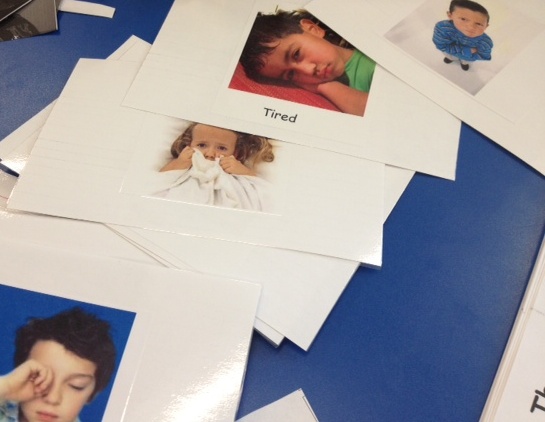
The Way I Feel was great with ALL of our young age groups (3 year olds-2nd grade students). It was easy to modify the language throughout the story and match emotions pictures. Today I Feel Silly & Other Moods That Make My Day was was great for students Kindergarten through 2nd grade because it had more words and more details in the pictures throughout the story. How Are You Peeling? Foods with Moods was a little too "abstract" for my younger students to recognize the feelings or emotions depicted in the photos, but it was great for my 1st and 2nd grade students. While we read each of these books, we had the Emotions Cue Card handy to match feelings from the book to the photos on the cue card. Additionally, I collected many other Emotions Photos to match feelings and emotions throughout these stories. Several of our students have difficulty understanding and seeing that people depict similar emotions in slightly different ways, so we wanted to offer a variety "faces" for our students to help them see and understand the similarities/differences between faces and feelings. Here is one page of the Emotions Photos that I used for my students to match and describe emotions.


This Emotions Photos document is 4 pages of photos depicting Happy, Sad, Mad/Frustrated, Calm, Scared and Tired. You can grab it here. I turned these photos into cards by cutting the pictures out and laminating them onto large index cards.


While reading all of the Feelings books, we targeted goals such as Answering Basic Questions, Describing details in pictures and using Inference to determine the character's feelings. Each time we read the books, we used the Emotions Photos to match the feelings of the characters. For students in articulation therapy, we continued to use these books and activities and were able to focus on phonemes such as /f, s, sm, sk, l/ to name a few.

After reading each of the stories (over 2-3 sessions), we started making our own book of feelings. With our young kindergarten group, we have several students with low receptive/expressive language skills and poor social communication skills. In this group, we have targeted each emotion in our own book in 1-2 sessions. We started each "emotion exploration" using a computer software program called Faceland.


We LOVE this program because it teaches the students what "clues" to look for on faces to determine the emotion. Each new emotion that is taught is broken into 2-3 facial cues from the eyebrows/forehead, eyes, and mouth. This program also allows the students to see the same emotion depicted in slightly different ways between different people. There are also questions that it asks, and the students have to match the situation to the emotion. For our young students, we often have to act/draw out these questions to help them understand; however, it really helps them learn the feelings. There are even follow up games that go along with each emotion, so it is very engaging!

After going through Faceland, we started making our own book called "My Book of Feelings". Here are some sample pages from this book:


We took pictures of our students depicting the emotion that was stated on each page. This was easiest to do during our Faceland activities for some of our students. Others just needed the Emotions Cue Card or Emotion Photos and a mirror to match their own faces to the feelings. Some students enjoyed taking their picture using the iPad with the camera in "reverse" mode so that they could see themselves making the faces. Still, some of our youngest students (3 year olds) had a hard time making the faces that they were not feeling in the moment, so we improvised by using other pictures or catching them in the act! Needless to say, this was one of the most fun parts of the activity, and all of our students LOVE seeing pictures of themselves in their own books! Here is how one turned out!


Our students with expressive language impairments had some difficulty independently coming up with "things that make me feel ___" so I created a document with pictures for the kids to choose from. A sample of this document is pictured, but you can grab the entire document HERE.


We also found that different students had different feelings about the pictures offered. For example, one of our students feels HAPPY when tying her shoes but another said that this made him feel FRUSTRATED because it was hard for him.

For our youngegst students, we also used the Emotions Photos cards to discuss Similarities and Differences and the "I Feel __ When" cards to Categorize emotions. For our older students in speech/language therapy, we continued expanding this lesson by coming up with synonyms for the feeling words and using them to re-tell or create stories of our own. In their Book of Feelings, we made it harder by having them expand their own stories with their personal experiences.

This has been a great activity for ALL of our students. We have had the opportunity to learn so much about them and they have really improved their ability to describe their feelings and the feelings of others. AND, they will be able to share their books with their families for ongoing conversations at home!

We hope you find these activities useful with the speech, language, and social communication needs of your students! We'd love to know How You Feel about these activities and how we can make them even better!

   ~~Orlanda

December 11, 2012

Simple Speech ~ "The Gingerbread Man" : Activities to Target Speech, Language and Literacy

Wow! This semester in school is flying by, we only have 7 more days until Winter Break! I feel like I have been drowning in paperwork and evaluations and my student caseload keeps growing! Thankfully, we are in one of my favorite times of year, the Holiday Season!

Because I work with such a diverse population of students and cultural backgrounds, I really have to focus on choosing diverse activities that allow us to celebrate the season in many different ways. My favorite book to read this time of year is "The Gingerbread Man". It's a fun story about something that we all enjoy: COOKIES! This year, I have collected MANY versions of this story to enjoy with my students!


The goals that I target during these activities include the following:
Articulation/phonology: multi-syllable words/phrases; final consonants; phonemes: "dge", /f/, /k/
Receptive language: Recognizing animals, actions, positions
Expressive Language:  Core Vocabulary--"In, Out, Go, Run, He, She, They"; Answer Who, What Doing, Where and Why Questions; Problem solving; Inference; Predicting; Story Grammar; Sequence; Re-telling stories, Compare/Contrast
Pragmatic Language: Feelings/emotions, Non-literal language/Metaphors ("Sly as a Fox")

I started by reading this version: "The Gingerbread Man". In this version, the fox tricks the gingerbread man by telling him, "Come closer, I can't hear you". The kids love this one because we all YELL together like the gingerbread man, "I have run away from . . . .!" and then we list all of the characters.


Then I read this version of the book:

I talked to the students about "folk tales" and why there are different versions of this story. The second version of the story has more details about the process for making gingerbread and has new vocabulary like "sugary glaze". This version also has different characters from the first version of the story.

While reading each story, we focused on the articulation and phonology goals using the repetitive text "Run, Run as fast as you can, you can't catch me, I'm the gingerbread man!" Then, after reading each story (usually during the second session), we retold the story using this visual that I created: Retell the Story. This is a great tool that we used to identify the Story Parts and practice Sequence skills. This is also helpful for identifying details and events from the a story.

After retelling each version of the story. We were worked on compare/contrast of the stories. I use a simple Venn diagram to compare/contrast the stories. I found a new idea on how to do this on Pinterest using paper plates. What a great idea! Here is the link to the post: Paper Plate Venn Diagrams


The kids have been so engaged that I sought out many more versions of this story and have them laid out. They ask every day which book we will read next! So, we also read these stories and completed the same kinds of activities. Here they are:


The kids have done such a great job and have been really engaged in pointing out similarities and differences while we have read the books. I have been using these activities with Pre-K through 2nd grade students. I even used the first version of this story in my youngest pre-school group. I found lots of Gingerbread Man activities on various websites, here are some of my favorites!

Sequence pictures and a mini book:

Gingerbread Man themed games and websites:

YouTube Links for Gingerbread Man story and How to Make Gingerbread cookies:

I really like the video "Gingerbread Men Recipe Demonstration". It's kind of long, so I fast-forwarded many parts, but it was great for my students to see the process for making gingerbread cookies. Many of them thought that decorating and eating were the only steps! The last activity that I did with the kids was to make cookies with them. I had them list the steps for making the cookies and I purchased some Gingerbread Cookie Mix. We did this hands on activity to complete the recipe, bake the cookies, decorate, and EAT (everyone's favorite).

If you have students with diet restrictions or have limitations in making real cookies, we also had lots of fun using the Cookie Doodle app on the iPad. Using this app, you and your students can walk through the steps of mixing the ingredients, baking, and decorating. It's fun, too!


I hope you have fun using some of these Simple Speech "holiday themed" activities with your students! What are your favorite books or activities to use during the holiday season?

~Orlanda

October 22, 2012

"Halloween" Themed Books AND Core Vocabulary!

 
Halloween is one of my favorite holidays and it lends itself to so many great activities for speech and language learning and functional communication use. I have been working with several teachers (including my parnter, Kelley) to spread CORE vocabulary into many classrooms, and this week I have found a few books to help me combine these two FUN concepts.
 
The first story I used came from an OLD book, "Storytime: Holiday Fun" by Pati King-DeBaun (1993). The story I pulled from this book is called "Stirring the Brew". I have had this tool in my "toolbox" since my first year as an SLP (I actually found a note attached from my CF supervisor!--Thanks, Penny!) Unfortunately this book is now out of print, so I couldn't find it to share. I DID find a photo of it online though! Here it is:


The concept of this story is simple and REPETITIVE. Each page turn shows a witch stirring the brew and then adding various items such as cats, ghosts, bats, spider webs, pumpkins and goblins. This would be a fairly easy concept to make on your own. I LOVED this book for TWO reasons. . . 1)It is repetitive and by the 2nd page, even my kiddos with limited verbal skills were singing the carrier phrase "stirring and stirring the brew, P. U!" and 2) There were many opportunities to use the CORE word "in". While I read this story to my students, I also had a "cauldron" that I found on sale at Target (I found it near the traditional "pumpkin" buckets). I had pictures of each item from the story and a spoon for each student. I also had large picture symbols of the core word that I was working on with the students "in" and later we added "out".


I also found a pre-made board from Boardmakershare.com that depicts some images to pair with this story. Visit the link HERE .


Another book I used last week to incorporate CORE vocabulary was the story "Big Pumpkin" by Erica Silverman. Fortunately I was able to find MANY activities online to go with this book.
For this story, we focused on the CORE words "ON" and "OFF". I started by practicing ON and OFF using small objects and large blocks. I also made large picture cards to depict the "symbol" to associate with each word.


I love this story because it is repetitive with carrier phrases and adds a new character to each page. My kids especially loved when I would "change" my voice while reading each page. This story also leant itself to many great questions and vocabulary words, and of course, story elements. For my youngest students, I used picture symbols to help them focus on the the concept "ON". Our carrier phrase was "the (witch) pulled, the pumpkin stayed ON". I also found these awesome links with visuals to add to the story activities!
  • Vocabulary cards HERE
  • Literacy activities, coloring sheets, sequence cards, & craft activities HERE
  • Poem, Story Re-tell, and Book report HERE
  • Boardmaker Story board and picture symbols HERE


The last story that I have used this month to work on CORE vocabulary is "The Little Old Lady Who Wasn't Afraid of Anything" by Linda Williams.

I love this story for MANY reasons in addition to the CORE vocabulary that is targeted. The carrier phrase that I focused on with core words was "SHE said, I am not afraid of YOU". The anticipation in this book made it very exciting to read and re-tell many times! I created this visual to teach the core words "YOU", "I", "SHE" and "HE", all of which can be used with this book and it's repetitive text.

I also found many other amazing online activities to pair with this story!
  • Literacy, Art, and Circle Time activities HERE
  • Story board and picture symbols HERE
  • Boardmaker Communication Board HERE
  
This school year, I have added many new students to my caseload and many new students with limited verbal skills and/or poor general intelligibility of speech. My "knee-jerk" response was to GO CORE with more students. If you have not yet gone "CORE", I encourage you to research this topic and you will see some pretty amazing results.

Thank you Gail Van Tatenhove for your amazing work in this area!

~Orlanda

September 29, 2012

Game Time in Speech Therapy: "Guess What I Am"

Who likes to have fun?! We do! We do!

When working with children with various types of abilities such as in speech/language therapy and in special education, we are constantly trying to keep it motivating. "Game Time" is a great way to work on MANY speech, language, and social communicaiton/interaction skills. We are NO STRANGER to Game Time!

I came accross this game "Guess What I Am" a few years ago while I was observing a speech therapy session of an SLP that I supervised. It's made by Techno Source and I found my copy at Toys R Us for about $12 (pretty sure I had a sale or coupon deal!) I have also seen it on Amazon.com.


The game comes with cardboard characters with a large whole cut out for a face. All of the characters in this game are either animals or people. The game also comes with tokens and a die. The die is "non-traditional" and has multiple sides with the options "Ask", "Guess", "Lose a Turn", "Reverse", and "Wild".


The game itself is pretty simple. Students choose a cardboard character (without peeking) and place it in front of their face (this makes EVERYONE laugh at how silly everyone looks). Then the student has to ask a variety of quesitons in order to guess what they are. If you choose to follow the game format in the instructions, the die dictates whether you get to "ask" or "guess". The best part about this game is the variety of ways I have found to play it (aside from the way the instructions are written). Afterall, I really like to get the best "bang for my buck" when I'm choosing materials for speech sessions! Here are some ways we play and the goals we target:

Semi-Traditional #1: The traditional way of playing is great for basic asking questions and describing. I change it slightly and only have one student as the "character" at a time, and the others are the "clue givers" (in this version, I omit the use of the die). Many of the students are working on asking questions. Some are working on formulating questions with correct grammar, while some are working on figuring out what to ask so they can gain more information. I also require them to direct their question to a particular student by saying each person's name. This also allows for embedding social skills such as making eye contact, responding to your name, turn taking, showing attentive listening, and responding to questions. I also have the "character" recall and re-tell all of their clues after each question, and I usually require that they ask at least 2 questions before making a guess. Having the students recall each clue really helps their reasoning skills in this game. I found that when students do this, it helps improve their reasoning skills, because otherwise, they continued making guesses with little regard to the information they were given. For some students, it's also helpful to write down their clues or pair them with simple pictures to help their memory. Describing skills are also important and the "clue givers" are expected to use good descriptive vocabulary to provide "clues" to their friends. Since some of my students have a harder time with this than others, I created this tool to help them formulate questions and ideas: Guess What I Am--Visual Tool.

Semi_Traditional #2: In this format of the game, often with older students (2nd grade or higher), we use the die to keep it interesting and add a competetive edge. I also like to require this age group to limit their quesitons to "yes" or "no" type questions. This type of questioning really makes the game more challenging as they have to filter through "possible" descriptors of their characters. With this age group, we talk about how to "funnel" through questions by starting with broad categorizations and then narrowing down the options based on the responses of the "clue givers".

Additional social skills that we target using this game include: following rules and "cheating", identifying thoughts/feelings of peers when rules "are" or "are not" followed, whole body listening, and topic maintenance.

Overall, this is a great game to have on your shelf, and I definitely recommend it! What other ways do you think you would use this game? I'd love to hear your ideas!

~Orlanda


May 5, 2012

Have you Heard? APPS Sale Ends May 9th!!!!!

In honor of Better Speech and Hearing Month, Super Duper Inc. is putting all of their "Fun Deck" apps on sale for $1.99 until May 9th!!!! Most of these apps are usually $3.99-$5.99 and the "card deck" version of these are usually $10.95. If you have access to iPod Touch, iPhone, or iPad, these apps are digital versions of several "Fun Decks" that we use in the speech room and with our social thinking groups. Now, in APP form, they are more cost effective (and let's face it, we are all on tight budgets these days)!! Here is a list of Apps that work for various groups of students at ANY age level! I have divided the apps by how they can be used in speech therapy or in social thinking groups. Also, I have added a group that would work well as "writing prompts" that might be useful in a speech room, resource, inclusion, or classroom setting. Follow this link for the sale list if you are interested!  


Articulation Therapy--For students who are beginning to practice their sounds at the SENTENCE level and beyond, these Apps are great for carry-over of skills.

·     What's Being Said? Fun Deck
·     What Are they Asking? Fun Deck
·     What Are They Thinking? Fun Deck
·     Story Starters Fun Deck
Language Therapy--These Apps are divided by "type" of language to target. If your child is working on the type of language listed, these would be great tools to add.
  • Answering Questions:
o  Yes or No? Fun Deck
o  WH Questions at Home Fun Deck
o  WH Questions at School Fun Deck
o  How? Fun Deck
o  Following directions
·     Understanding and using correct Grammar and Syntax
o  Using I & Me (free)
o  Do and Does
o  Was & Were
o  Has & Have
o  Regular Past Tense Verbs
o  Irregular Verbs
o  Plurals
o  What Does Miss Bee See?
o  What's Being Said?
o  What are They Asking?
o  Story Starters
·     Improving Descriptive Language
o  What Doesn't Belong?
o  Compare and Contrast
o  Opposites
o  Homophones
o  Name That Category
o  Let's Name Things (free)
o  Story Starters
·     Expressive Reasoning (Inference, Predict, Problem solve)
o  Let's predict
o  What's Being Said?
o  What are They Asking?
o  Fact or Opinion?
o  How?
o  What would you Do at Home if...
o  What would you Do at School if...
o  How would you Feel if...
o  If...Then...
o  Understanding Inferences
o  Story Starters
o  What are They thinking?
·     Social communication
o  (Many of the expressive reasoning Apps would be helpful!)
o  Practicing Pragmatics
o  All About you, All About me
o  What are They Thinking?
o  How would you Feel if?
Fluency therapy--There are many descriptive and great pictures and scenes that can be used in these apps to practice Fluency strategies!

·     What's Being Said?
·     What Are They Asking?
·     What would you do if...
·     What are they Thinking?
·     Story Starters

Written Expression--There are many great photos and picture scenes that can be used in these apps to use as writing prompts.
  • What Does Miss Bee See?
  • How? Fun Deck
  • What's Being Said?
  • What are They Asking?
  • Story Starters
  • What would you Do at Home if..
  • What would you Do at School if...
  • How would you Feel if...
  • If...Then...
  • What are They thinking?
Many of these products have video tutorials online if you follow the link to Super Duper (this is where I get many of my own ideas). I don't work for Super Duper or their promotions team and I am not receiving any payment or merchandise for promoting their products; but I have hands on experience with many of their products, and I'm always looking for new ways to keep our students motivated to achieve their communication goals! 

Hope you can add to your toolbox! 
~Orlanda