Orlanda and I have spent a considerable amount of time over the past 6 weeks in our collaborative speech/social thinking groups working with our "littles" on basic play skills and sharing. We have two small groups (4 kids each) that we needed to target these skills. One group is made up solely of Kinder students who have significant speech and language delays (both articulation and pragmatic language) and ADHD. The second group is made up of Kinder and 1st grade students who all have pragmatic language deficits, but are "higher" than the first group. The students in this group have Autism Spectrum Disorder and Speech Impairment.
We grouped the lessons in this unit into indoor play skills and outdoor play skills.
During the outdoor play lessons we listed different activities that the kids like to play outside and which were solitary activities vs activities they do with others. After choosing a few of the most common activities on the lists, we taught the explicit rules and defined the "hidden rules" for those activities. We read portions of The Social Skills Picture Book by Jed Baker, PhD that related to outdoor play.
We then took the kids outside to the Kinder playground when no other students were outside to practice taking turns with the balls and playing a simple game that required joint attention. The kids did a great job.
Next, we began to target indoor play skills. We specifically wanted to make sure to address the kinds of activities the kids engage in Kindergarten and 1st grade "centers". We again made lists of activities they did indoors and divided them into solitary vs activities done with others. We read applicable parts from The Social Skills Picture Book again and discussed "hidden rules" for playing with others during centers. We spent several sessions watching and discussing the lessons on sharing and taking turns from Playtime with Zeebu. The kids loved Zeebu and it provides a great anchor to remind students to share in the inclusion setting.
We spent a session reading a picture book on sharing. For the Kinder students with less language sophistication, we read Will Sheila Share? by Elivia Savadier. For the combo Kinder/1st grade group, we read I Am Extremely Absolutely Boiling by Lauren Child.
Finally, we spent several sessions practicing sharing and indoor play.
During the first session, we used wooden trains and train tracks (which
worked really well since there is an example of sharing/not sharing with
trains in the Zeebu video). During the second session we used Legos.
Before the first session we spent time teaching various phrases that
could be used to initiate play and to help facilitate sharing using this
visual.
When we played with train tracks I initially "controlled" access to the tracks handing out one or two to each child and then prompting them to use the scripts to ask for more from me or from a peer. When we did the Lego activity, Orlanda gave each child a small pile of Legos that they eagerly started building with individually. Sure enough, they soon wanted more. They were prompted to ask a friend for a piece. Ya gotta love a little sabotage! :) We do have a few students who we wanted to target accepting "no thanks" from their peer for an answer while we also had one particular student who tends to get run over by his peers and we wanted to help him know it was ok to say "no thanks" at times. This led to some interesting interactions!
I have worked on generalizing the skills from small group to the inclusion classroom by using this powerpoint social story. I just load it on one of the classroom computers in the specific classrooms and prompt the kids to read it (either independently or with me) before center time. Feel free to download it for your use!
I hope that you will find the lesson ideas and tools to be useful with your students. ~ Kelley
November 4, 2012
November 1, 2012
Welcome to the Vocabulary Parade!
I'll admit I've been in a bit of a funk this past month -- too many obligations, too little time. I know that is a universal feeling out there among educators at one point or another in the year.
Yesterday, however, we had a great activity at school that pumped my enthusiasm back up and I'm already brainstorming ideas about how to incorporate instruction in idioms and vocabulary next year with my students. Instead of the usual Halloween based events, our school hosted our first annual Vocabulary Parade. This idea was based on the book Miss Alaineus: A Vocabulary Disaster by Debra Frasier. Our students were asked to choose a vocabulary word and create a costume that would define that word. We then all gathered in front of the school and were led by the high school drum line in a parade. It was absolutely adorable!
I just thought I would share the costumes Orlanda and I came up with. Orlanda's word was "communicate" (of course!) and mind was "deduce" (a la You are a Social Detective by Michelle Garcia Winner & Pamela Crooke). Next year I'm on the hunt for a yellow trench coat! ~ Kelley
October 22, 2012
"Halloween" Themed Books AND Core Vocabulary!
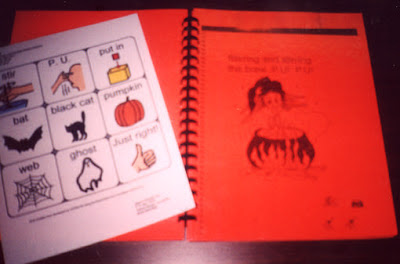
I also found a pre-made board from Boardmakershare.com that depicts some images to pair with this story. Visit the link HERE .
Another book I used last week to incorporate CORE vocabulary was the story "Big Pumpkin" by Erica Silverman. Fortunately I was able to find MANY activities online to go with this book.
For this story, we focused on the CORE words "ON" and "OFF". I started by practicing ON and OFF using small objects and large blocks. I also made large picture cards to depict the "symbol" to associate with each word.
I love this story because it is repetitive with carrier phrases and adds a new character to each page. My kids especially loved when I would "change" my voice while reading each page. This story also leant itself to many great questions and vocabulary words, and of course, story elements. For my youngest students, I used picture symbols to help them focus on the the concept "ON". Our carrier phrase was "the (witch) pulled, the pumpkin stayed ON". I also found these awesome links with visuals to add to the story activities!
- Vocabulary cards HERE
- Literacy activities, coloring sheets, sequence cards, & craft activities HERE
- Poem, Story Re-tell, and Book report HERE
- Boardmaker Story board and picture symbols HERE
The last story that I have used this month to work on CORE vocabulary is "The Little Old Lady Who Wasn't Afraid of Anything" by Linda Williams.
I love this story for MANY reasons in addition to the CORE vocabulary that is targeted. The carrier phrase that I focused on with core words was "SHE said, I am not afraid of YOU". The anticipation in this book made it very exciting to read and re-tell many times! I created this visual to teach the core words "YOU", "I", "SHE" and "HE", all of which can be used with this book and it's repetitive text.
I also found many other amazing online activities to pair with this story!
- Literacy, Art, and Circle Time activities HERE
- Story board and picture symbols HERE
- Boardmaker Communication Board HERE
Thank you Gail Van Tatenhove for your amazing work in this area!
~Orlanda
September 29, 2012
Game Time in Speech Therapy: "Guess What I Am"
Who likes to have fun?! We do! We do!
When working with children with various types of abilities such as in speech/language therapy and in special education, we are constantly trying to keep it motivating. "Game Time" is a great way to work on MANY speech, language, and social communicaiton/interaction skills. We are NO STRANGER to Game Time!
I came accross this game "Guess What I Am" a few years ago while I was observing a speech therapy session of an SLP that I supervised. It's made by Techno Source and I found my copy at Toys R Us for about $12 (pretty sure I had a sale or coupon deal!) I have also seen it on Amazon.com.
The game comes with cardboard characters with a large whole cut out for a face. All of the characters in this game are either animals or people. The game also comes with tokens and a die. The die is "non-traditional" and has multiple sides with the options "Ask", "Guess", "Lose a Turn", "Reverse", and "Wild".
The game itself is pretty simple. Students choose a cardboard character (without peeking) and place it in front of their face (this makes EVERYONE laugh at how silly everyone looks). Then the student has to ask a variety of quesitons in order to guess what they are. If you choose to follow the game format in the instructions, the die dictates whether you get to "ask" or "guess". The best part about this game is the variety of ways I have found to play it (aside from the way the instructions are written). Afterall, I really like to get the best "bang for my buck" when I'm choosing materials for speech sessions! Here are some ways we play and the goals we target:
Semi-Traditional #1: The traditional way of playing is great for basic asking questions and describing. I change it slightly and only have one student as the "character" at a time, and the others are the "clue givers" (in this version, I omit the use of the die). Many of the students are working on asking questions. Some are working on formulating questions with correct grammar, while some are working on figuring out what to ask so they can gain more information. I also require them to direct their question to a particular student by saying each person's name. This also allows for embedding social skills such as making eye contact, responding to your name, turn taking, showing attentive listening, and responding to questions. I also have the "character" recall and re-tell all of their clues after each question, and I usually require that they ask at least 2 questions before making a guess. Having the students recall each clue really helps their reasoning skills in this game. I found that when students do this, it helps improve their reasoning skills, because otherwise, they continued making guesses with little regard to the information they were given. For some students, it's also helpful to write down their clues or pair them with simple pictures to help their memory. Describing skills are also important and the "clue givers" are expected to use good descriptive vocabulary to provide "clues" to their friends. Since some of my students have a harder time with this than others, I created this tool to help them formulate questions and ideas: Guess What I Am--Visual Tool.
Semi_Traditional #2: In this format of the game, often with older students (2nd grade or higher), we use the die to keep it interesting and add a competetive edge. I also like to require this age group to limit their quesitons to "yes" or "no" type questions. This type of questioning really makes the game more challenging as they have to filter through "possible" descriptors of their characters. With this age group, we talk about how to "funnel" through questions by starting with broad categorizations and then narrowing down the options based on the responses of the "clue givers".
Additional social skills that we target using this game include: following rules and "cheating", identifying thoughts/feelings of peers when rules "are" or "are not" followed, whole body listening, and topic maintenance.
Overall, this is a great game to have on your shelf, and I definitely recommend it! What other ways do you think you would use this game? I'd love to hear your ideas!
~Orlanda
September 18, 2012
My Favorite Lesson Planner
I've never been able to use a lesson plan book because there are not enough compartments in the day. I teach anywhere from 6-10 lessons a day depending on the schedule. I've tried various ways of lesson planning in the past, but I finally found a system last year that worked well for me. I created a template from a simple Word document so I can add or delete columns each semester as needed.
This year I had to add a second page. I now have one page with academic lessons...
and one for Social Thinking Groups...
I hole punch the pages each week and hang them with notebook rings on the front of an open file box.
The box contains info that I need at my fingertips. I like this system because it keeps the lesson plans within sight. Since Orlanda and I co-teach social groups, she can also view the lesson plans if I am held up with a student issue.
If you'd like to use this template, feel free to download it here.
I'd love to hear about how you write your lesson plans. Please share your ideas in the comments!
Please join as a follower if you haven't already!
~Kelley
This year I had to add a second page. I now have one page with academic lessons...
and one for Social Thinking Groups...
I hole punch the pages each week and hang them with notebook rings on the front of an open file box.
The box contains info that I need at my fingertips. I like this system because it keeps the lesson plans within sight. Since Orlanda and I co-teach social groups, she can also view the lesson plans if I am held up with a student issue.
If you'd like to use this template, feel free to download it here.

Please join as a follower if you haven't already!
~Kelley
Subscribe to:
Posts (Atom)